One Shot, One Life: Joe Johnson Looks Back on the Miracle of 1986

The Dream That Didn't Feel Real
Picture the Crucible in the spring of 1986. The baize glows under television lights, the hush between shots so complete you could hear a cue tip split the silence. Somewhere in the arena sits a man who began that fortnight as a 150-1 outsider — a former gas board worker, a factory hand, a father of six who had never won a single match at this theatre before. And yet, when it was over, Joe Johnson was world snooker champion.
"I was thinking: 'Is it really me?'" Johnson tells the story now with the same disbelief that crossed his face four decades ago. "I couldn't get my breath because I expected Steve to beat me." At 73, sitting quietly in Chiswick during his stint as a TNT Sports commentator at the current World Championship, there is still something almost childlike in the way he describes that night — not naive exactly, but genuinely, permanently amazed. "When I beat him and won £70,000, which was a huge amount of money then, it really was a beautiful dream."
Britain Was Snooker Loopy — and Johnson Was Its Unlikeliest Hero
The 1986 World Championship final between Johnson and Steve Davis was watched by 18 million people on the BBC. That figure alone tells you everything about where snooker sat in the national conversation at the time. Davis had already been world champion three times. He was the machine, the ice-cool favourite, the man who had turned professional dominance into an art form. Johnson, by contrast, had spent years scrambling to justify his pro card, signed on in 1982 while doubting his own ability, and had only turned professional in 1979 at the relatively late age of 27 — a year after reaching the World Amateur Championship final.
He had faced experienced professionals who, as he puts it with characteristic honesty, "knew how to stop an up-and-coming kid." The year before his triumph, he had been knocked out in the first round by Bill Werbeniuk — a man famous for consuming an almost mythological quantity of beer during matches. Snooker in the mid-eighties was a gloriously eccentric world, and Johnson belonged to it completely, even if the rankings didn't always reflect that.
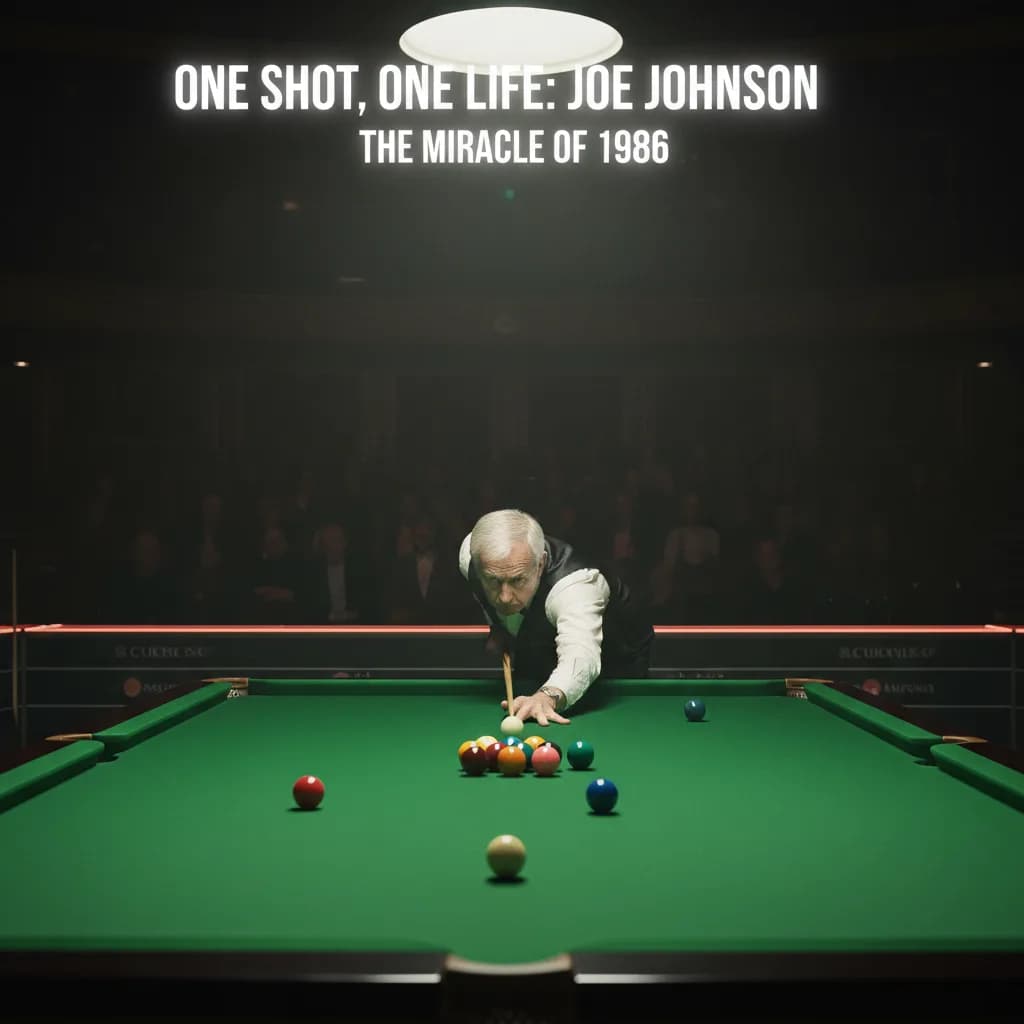
Then came 1986, and everything changed on the flight path of a single red. "My life changes on one shot," Johnson has said. The attacking snooker he produced in that final was not a fluke or a happy accident — it was the expression of genuine talent finally finding its moment. Davis, for once, had no answer.
Fame, Royalty, and a Hit Record
What followed Johnson's victory had the texture of a particularly vivid fever dream. He became, almost overnight, outrageously famous — the kind of fame that has you being mobbed in Tesco and watching tennis alongside Princess Diana. He became the lead singer of a band called Made In Japan, who went on to have a hit record. In the Britain of 1986, snooker champions could apparently do anything.
He reached the World Championship final again in 1987, though this time Davis took his revenge. Beyond Sheffield, ranking tournament victories proved elusive, and the vast house purchased in the flush of his world title eventually had to be sold. The glittering peak had passed, and the descent was difficult. Johnson survived seven heart attacks — a statistic that reframes everything that went before it, lending his story a weight that goes far beyond sport.
Growing Up in Bradford — and the Resilience Behind the Smile
What strikes anyone who speaks to Johnson is the absence of bitterness. This is a man who endured racism while growing up mixed-race in Bradford, who spent years as a professional barely making ends meet, who watched his career fade after its single extraordinary flourish, and who has stared down serious illness more times than most people could imagine. And yet the words, by his own account, simply tumble from him — warmly, generously, without score-settling.
That generosity of spirit perhaps explains why the 1986 story endures so powerfully. Johnson didn't just beat Steve Davis; he reminded a watching nation that sport can still produce the genuinely improbable. In an era before social media could manufacture a narrative overnight, his was a story that spread person to person, street to street, because people simply could not believe it was true.
Forty years on, sitting in west London while the next generation battles it out at the Crucible he once conquered, Joe Johnson seems at peace with the shape his life has taken. The dream was real, even if it felt otherwise. The shot went in. Everything changed. And somehow, against all the odds, the man is still here to tell us about it.
