Crucible Secures £45m Revamp as World Championship Home Until 2045

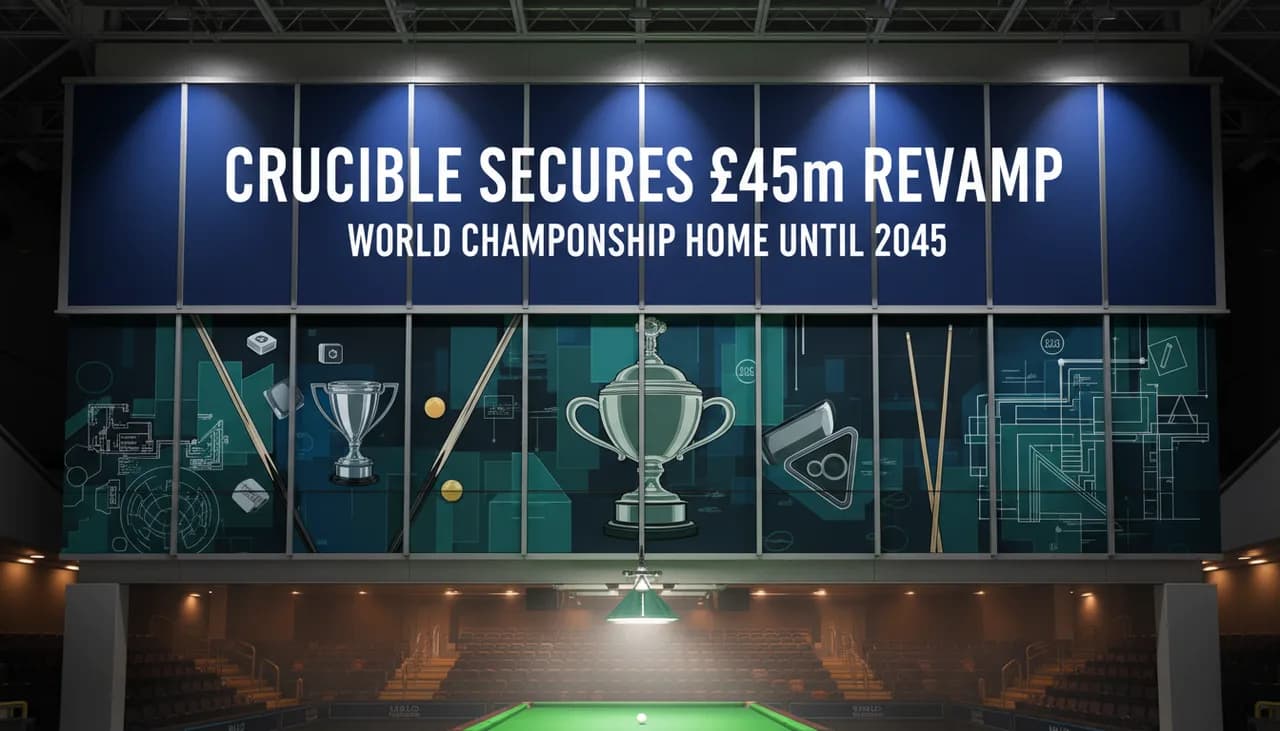
Long-Term Deal Ends Uncertainty Over Snooker's Most Iconic Venue
The World Snooker Championship will remain at the Crucible Theatre in Sheffield until at least 2045, following the announcement of a landmark long-term agreement on 24 March 2026. The deal, which also carries an option to extend through to 2050, brings to a close a prolonged period of uncertainty over the future of snooker's most prestigious address. The previous arrangement had been due to expire in 2027, and as recently as April 2025, Matchroom Sport president Barry Hearn had warned publicly that the tournament would be forced to relocate if the venue was neither refurbished nor replaced.
£45m Redevelopment: What the Figures Tell Us
The redevelopment of the 980-capacity theatre carries a total cost of £45 million, with the funding split clearly delineated. National and local government will contribute £35 million — representing 77.8% of the overall investment — while the remaining £10 million will be sourced from the private sector. The scale of public commitment underlines the cultural and economic weight that Sheffield and the wider sporting landscape attach to retaining the event.
As part of the construction timeline, the 2029 World Championship will be staged at an alternative venue whilst work is completed following the 2028 edition. Once the refurbishment is finished, the reconfigured Crucible is planned to present snooker in the round — a significant departure from the current layout, where one end of the theatre accommodates the playing area. Capacity will also increase by up to 500 additional seats, addressing one of the most persistent criticisms levelled at the existing set-up, alongside enhancements to general spectator facilities.
A Venue With Nearly Five Decades of History
The Crucible has hosted the World Championship without interruption since 1977, making it one of the longest-running venue partnerships in professional sport. Across that span, it has witnessed 48 world champions, from John Spencer's victory in the inaugural Sheffield edition through to Zhao Xintong's historic triumph in May 2025 — the first Chinese player to claim the title. That milestone, achieved in front of a sold-out Crucible audience, further reinforced the tournament's global significance at a moment when the sport's footprint in Asia continues to expand.
The debate over the venue's future had, at various points, drawn attention to China and Saudi Arabia as potential alternative hosts — territories with both the financial resources and the growing appetite for snooker to stage a flagship event of this magnitude. Hearn addressed that tension directly upon confirmation of the new deal, telling BBC Sport: "This is the deal that everyone ends up with bread in their mouth." His comments acknowledged the commercial pressures whilst reaffirming a preference for continuity at the Sheffield theatre.
The Capacity Debate: Players and Fans Divided
The question of the Crucible's size has long divided opinion within the sport. With a two-table configuration in place until the semi-final stage, the playing environment is notably intimate — a characteristic that generates an atmosphere unlike almost any other sporting venue, but one that also places players in close proximity to a partisan crowd. Ronnie O'Sullivan and Iran's Hossein Vafaei have both been vocal critics of the space constraints, whilst 2005 champion Shaun Murphy has described it as "holy ground" for competitors — a sentiment that reflects the reverence many professionals hold for the venue's history.
The planned increase in seating capacity will go some way towards resolving the commercial limitations of the current footprint, whilst the move to an in-the-round presentation format promises a more immersive experience for spectators and, potentially, television audiences. With the BBC holding the UK broadcast rights to the event, any visual upgrade to the arena's configuration carries obvious implications for production value and wider audience engagement.
Outlook: Stability Through to Mid-Century
With the deal now confirmed, the World Snooker Championship has a fixed home for the next two decades and potentially beyond. For a sport that has navigated considerable commercial turbulence over the past 30 years — from near-collapse in the late 1990s to its current position as a genuinely global product — the security of a long-term venue agreement at a site carrying almost 50 years of accumulated prestige represents a meaningful structural development. The 2045 horizon takes the tournament well into an era in which the next generation of players, many of them still in their formative years, will be competing for snooker's most coveted prize at the same address that gave the sport its defining stage.
