The Crucible Is Getting a £45m Facelift — And Snooker's Soul Stays in Sheffield

A Cathedral Gets Its Restoration
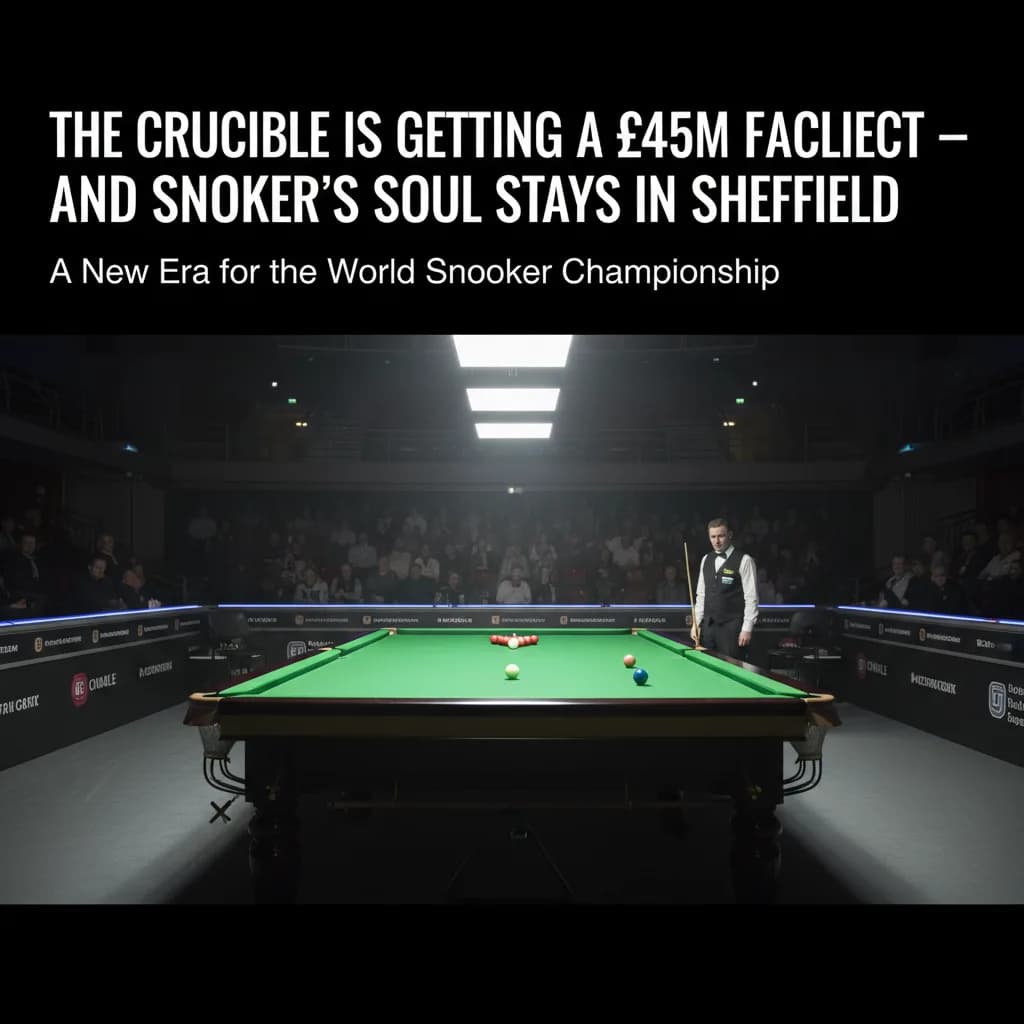
There is a moment, every April, when the lights drop in Sheffield's Crucible Theatre and the murmur of the crowd fades to something close to silence. The referee calls the players in. The balls are racked. And somehow, in that hush, nearly five decades of snooker history seem to press down from the walls. It is a feeling you don't get at an arena show or a televised exhibition. It belongs entirely to this place — and now, thanks to a £45 million investment, it will belong to it for at least another two decades.
Sheffield City Council has confirmed that the Crucible is set for a major refurbishment that will add up to 500 seats to the famous venue, securing the World Snooker Championship there until 2045. The announcement drew an immediate, characteristically direct response from Matchroom Sport president Barry Hearn, who described any alternative to the Crucible as simply "unthinkable." For once, even the most hardened cynics in the sport would struggle to argue with him.
More Than Bricks and Mortar
The Crucible's hold on snooker is not merely sentimental, though sentiment plays its part. Since the World Championship moved there in 1977 — the year John Spencer lifted the first title in those intimate surroundings — the venue has shaped the sport's identity as much as any player or promoter. It was here that Ronnie O'Sullivan compiled the fastest maximum break in history, here that Dennis Taylor sank that final black in 1985 in front of 18 million viewers, here that a teenage Stephen Hendry announced himself to the world. The stage has always been as much of the story as the protagonists.
What makes the Crucible so unusual — so irreplaceable, its supporters would say — is its intimacy. With a capacity currently sitting at around 980 for snooker, it is a small theatre that somehow generates an atmosphere most 20,000-seat arenas would envy. Every grimace is visible. Every miscue is audible. The distance between player and spectator is close enough that you can watch a man's hands shake on a pressure shot. The proposed expansion, bringing capacity up towards 1,500, will need to be handled carefully if that essential quality is to be preserved.
Why the Numbers Matter
The financial argument for the revamp is straightforward enough. Snooker's popularity has surged in recent years, driven partly by a new generation of Chinese stars — Ding Junhui, Zhao Xintong, Si Jiahao — and partly by the continued box-office magnetism of O'Sullivan, now a seven-time world champion. World Snooker Tour events are broadcast in over 100 countries. The Crucible's existing capacity, beloved as it is, leaves money on the table every single year. Thousands of fans apply for tickets in the ballot and never get close. Expanding the arena by even a modest number of seats represents meaningful additional revenue across a 17-day tournament.
The £45 million figure is also significant as a statement of intent. This is not a quick patch-up job. It signals that Sheffield, the WST, and the sport's commercial partners are committed to a long-term future for this venue rather than merely managing its decline. For a sport that spent much of the 1990s and 2000s battling for terrestrial television coverage and mainstream relevance, that kind of institutional confidence feels genuinely new.
'We're Talking About History'
Barry Hearn's phrase carries weight here. The Crucible is not just a building that hosts a snooker tournament. It is the building that made snooker what it is. The BBC's coverage, the late-night drama, the slow zoom on a player crouched over a crucial red — all of it has been shaped by the theatre's particular geometry and atmosphere. Moving the World Championship to a larger, more modern arena has been discussed periodically over the years, and each time the idea has been quietly shelved. The Crucible is simply too bound up in the tournament's mythology to be replaced without losing something fundamental.
Whether the revamp will change the atmosphere remains the real question fans are asking. Those 500 extra seats will bring in extra revenue and allow more people to witness the magic in person — both unambiguously good things. But the Crucible's genius has always been its compression: the sense that you are crammed into something important, something charged. Architects and planners will need to earn the trust of a fanbase that knows exactly what they stand to lose.
Still, as confirmation goes, this is about as reassuring as it gets. The World Snooker Championship will be played at the Crucible until at least 2045. A new generation of champions — some of them barely teenagers today — will win and lose here. The hush before the first frame will still fall, year after year, in Sheffield. Some things, thankfully, are bigger than renovation budgets.
