The Greatest Players Never to Win a World Snooker Championship

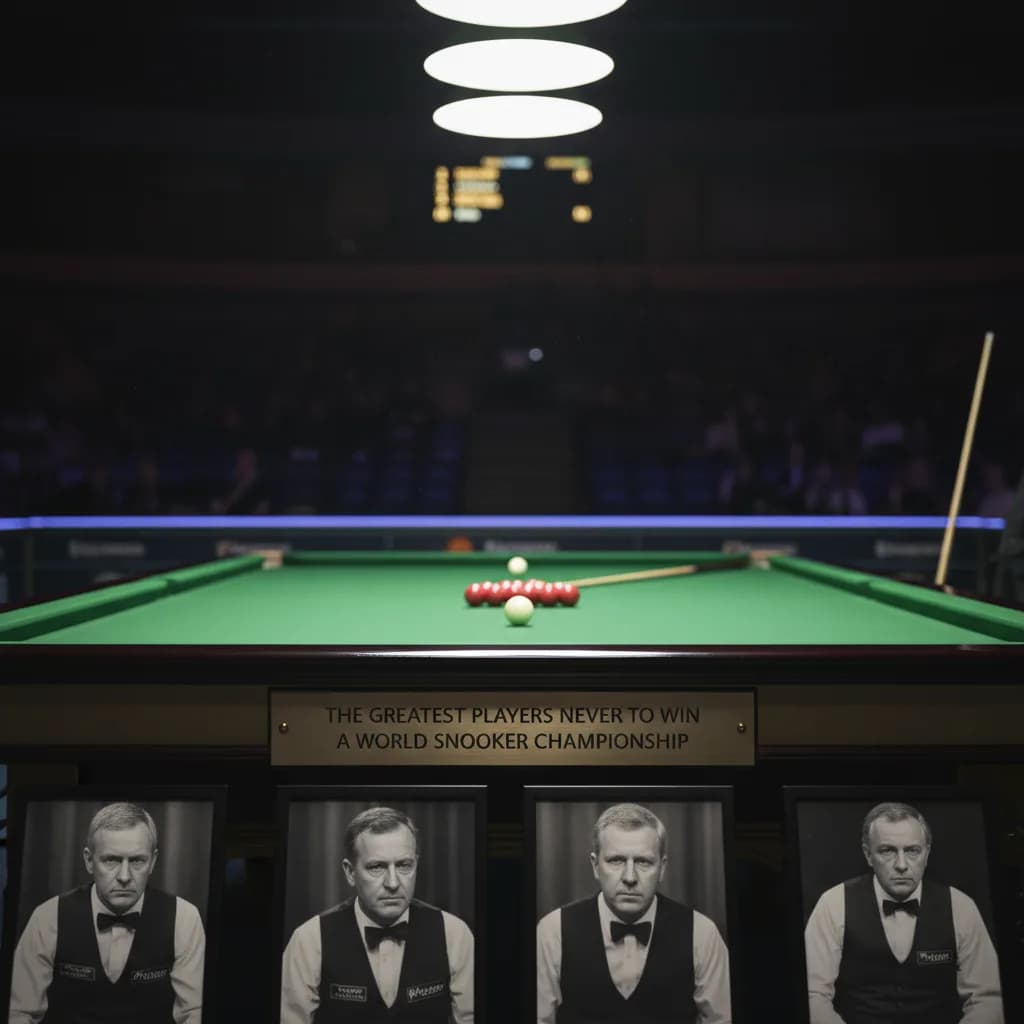
A Statistical Case for Snooker's Most Decorated Nearly Men
The World Snooker Championship at the Crucible Theatre remains the sport's ultimate prize — the one title that truly defines a career. Yet a handful of players throughout the modern era (1969 to present) have amassed remarkable records, accumulated ranking titles, and reached the summit of the world rankings, all without ever lifting the famous trophy. Identifying who deserves recognition as the finest among that group is no simple task, and any such exercise carries an inherent degree of subjectivity. That said, a structured points-based system goes a considerable way toward producing a fair and defensible ranking.
How the Points System Works
The methodology used to compile this list weighs three distinct areas of achievement. World Championship record forms the backbone of the assessment: final appearances are worth three points each, semi-final appearances earn two points, and quarter-final appearances one point. Beyond Crucible pedigree, a player's title haul is factored in — ranking event victories are worth one point each, Masters titles two points each, and other WPBSA/WST titles are awarded one, two, or three points depending on whether a player won one or more, five or more, or ten or more of them respectively. Finally, highest career world ranking is considered: reaching number one earns three points, number two earns two, and number three earns one. Where players finish level on points, their overall World Championship record serves as the tiebreaker.
Honourable Mentions
Several respected names narrowly miss the top ten under this system. Paul Hunter, who accumulated 12 points, merits a particular mention given the exceptional promise he showed before his tragic passing in October 2006, just days before what would have been his 28th birthday. The Leeds-born potter was a three-time Masters champion and widely regarded as a future world champion in waiting; had illness not intervened, he may well have gone on to remove himself from this conversation entirely. Doug Mountjoy also finishes on 12 points, with his two World Championship final appearances (1977 and 1981) underlining the quality he brought to the sport across his career. Stephen Lee and James Wattana each tally 11 points — Lee a seven-time ranking event winner, Wattana a player who reached the Crucible semi-finals on multiple occasions during the 1990s and early 2000s. All four are worthy of recognition even if the points system places them just outside the definitive list.
Context: Why This Exercise Matters
Snooker's World Championship occupies a unique position in the sport's hierarchy. Unlike many major titles on the calendar, it is contested over seventeen days at a single venue with a format that demands consistency, nerve, and tactical excellence in equal measure. The pressure of Sheffield is unlike anything else the circuit produces, which is precisely why some of the game's most gifted performers have fallen short across careers that were otherwise decorated with silverware. Understanding which players managed to get closest — and how frequently — adds genuine statistical texture to debates about the sport's all-time greats.
What the Data Tells Us
The points system is deliberately structured to reward sustained excellence at the Crucible above all else. A player with four final appearances but no title will score higher than one who reached four semi-finals — which seems appropriate given the marginal nature of what separates winning from losing at that level. Equally, the inclusion of ranking events and Masters titles ensures that overall career quality is reflected, not merely World Championship record in isolation. A player who reached the world final twice but never won another ranking event in their career would score lower than a multiple ranking champion with the same Crucible record — a nuance that adds depth to the final standings. All historical World Championship data referenced here is sourced from CueTracker and snooker.org.
A List That Continues to Evolve
One aspect of this exercise worth noting is that the list is not static. As current professionals age and retire, new candidates will enter the reckoning — or existing ones will accumulate further points through deep Crucible runs or additional title wins. Several players active on the tour today already have the statistical profile to feature prominently in future editions should they retire without claiming the world title. The conversation around snooker's finest unfulfilled careers, then, is very much ongoing. What the points system provides is a consistent, repeatable framework for having that conversation — one rooted in performance data rather than sentiment alone.
