Stan Moody at the Crucible: The 19-Year-Old Who Thinks Snooker Needs a New Generation

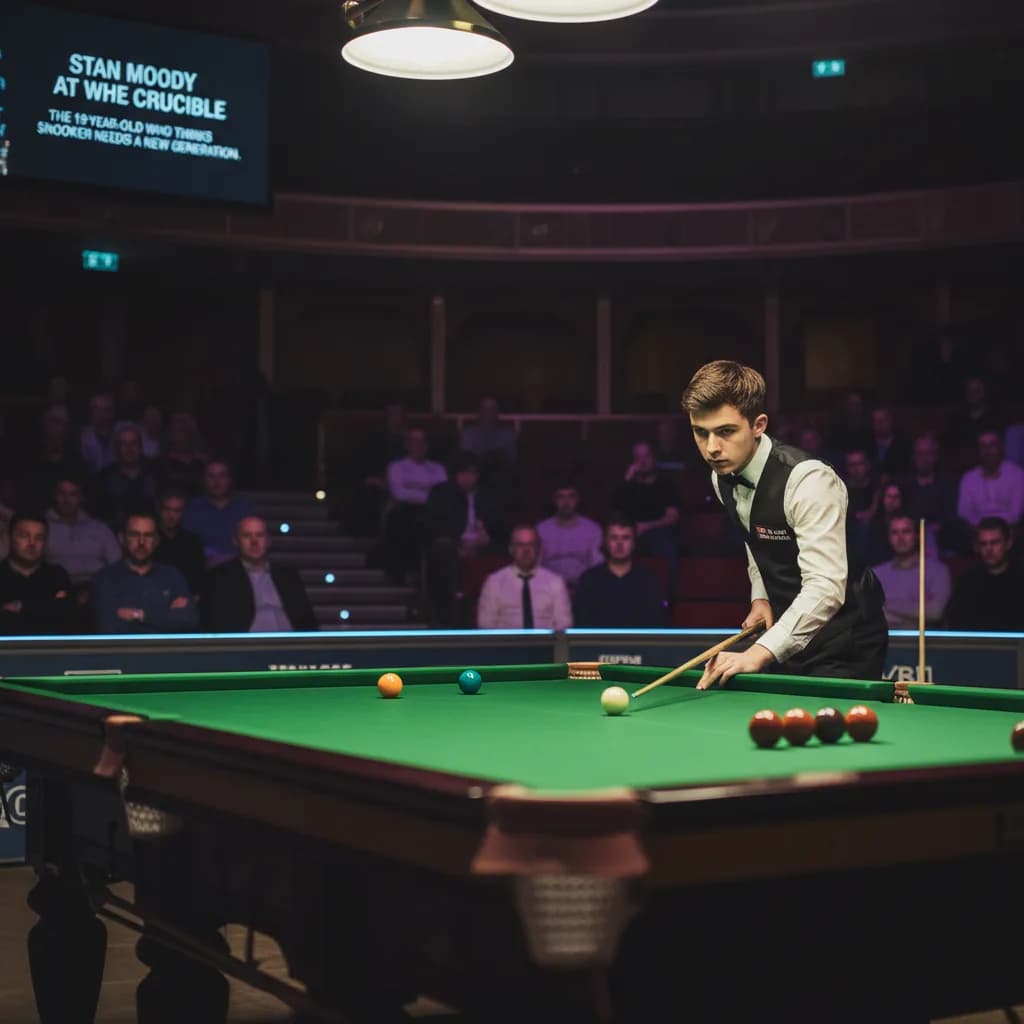
A teenager walks into the Crucible
There is a particular kind of silence that settles over the Crucible Theatre when a new name walks through that famous curtain for the very first time. Not the reverent hush of a crowd watching Ronnie O'Sullivan line up a century, but something closer to curiosity — a collective leaning-in. That was the atmosphere greeting Stan Moody on his World Championship debut, a 19-year-old from a generation that has grown up watching snooker on their phones as much as on television, stepping into a venue that has hosted the sport's greatest moments for nearly five decades.
Moody, competing in round one at the Crucible, described himself as "proud" to be making his debut at such a young age — and rightly so. Only a handful of teenagers have graced Sheffield's most celebrated stage in recent memory, and fewer still have arrived with the kind of self-possession that Moody carries. But beyond the personal milestone, the youngster made a point that resonates far wider than his own career: snooker, he believes, is in urgent need of new faces and fresh personalities.
More than just a debut
It would be easy to dismiss that sentiment as the enthusiasm of youth — a teenager speaking boldly before he has really earned the right to diagnose the sport's ills. But spend any time following the professional circuit and you begin to understand what Moody is getting at. Snooker has long been a sport that cherishes its legends, sometimes at the expense of celebrating what is coming next. Ronnie O'Sullivan, Mark Selby, John Higgins — titans, all of them, and rightly celebrated. Yet the sport's casual audience, the viewers who dip in and out during the World Championship fortnight, often struggle to name a player under 25 with genuine star quality.
That is not entirely the sport's fault. World Snooker Tour has invested heavily in expanding its calendar and its global footprint, with events now stretching from Saudi Arabia to Hong Kong. Viewing figures for the Crucible remain strong, and the BBC's coverage continues to draw millions. But personality — that ineffable quality that makes a sports star someone the public actually wants to follow — is harder to manufacture than a ranking point. It has to come from within, and it has to be allowed to breathe.
Moody, for his part, seems to have plenty of it. On his debut, he surged ahead of his opponent Gary Wilson, playing with a confidence that belied both his age and the weight of occasion. The Crucible can swallow young players whole — the intimacy of the arena, the knowledge that every safety shot and every missed red is being analysed by a room full of people who have watched the world's best for years. Moody appeared largely unbothered. There is something refreshing about watching a teenager play without the accumulated caution that settles over more experienced pros.
The next generation question
Snooker has seen generational shifts before, of course. When O'Sullivan burst onto the scene in the early 1990s, or when a teenage Ding Junhui lit up the 2005 Masters and changed the sport's relationship with China entirely, the effect was transformative. Both players brought not just talent but presence — a sense that something genuinely new was happening. The sport is overdue another moment like that.
There are promising signs. Si Jiahao, Jackson Page, Iulian Boiko — younger players are beginning to accumulate ranking points and attention. But making the leap from promising professional to genuine household name requires opportunity, exposure, and a sport that actively creates space for new voices to be heard. Moody's willingness to speak publicly about snooker's need for fresh personalities suggests he understands that the responsibility is partly his own.
For a 19-year-old to walk into the Crucible and play the way Moody did in round one is one thing. To walk out of a press conference and say, essentially, that the sport needs people like him — that takes a different kind of nerve entirely. Whether he backs it up over the coming days remains to be seen, but the statement itself is worth taking seriously.
Sheffield is watching
The World Championship has a way of revealing character. Seventeen days, the relentless best-of format, the noise of the crowd filtering through the curtain — it strips players down to what they actually are. Some veterans crumble here. Some teenagers discover themselves. Stan Moody has arrived at the Crucible not just hoping to win matches, but apparently hoping to prove a point about the sport's future. In snooker's most storied venue, that is exactly the kind of story worth following.
