Free Balls Explained: The Rule That Made O'Sullivan's 153 Possible

What Is a Free Ball?
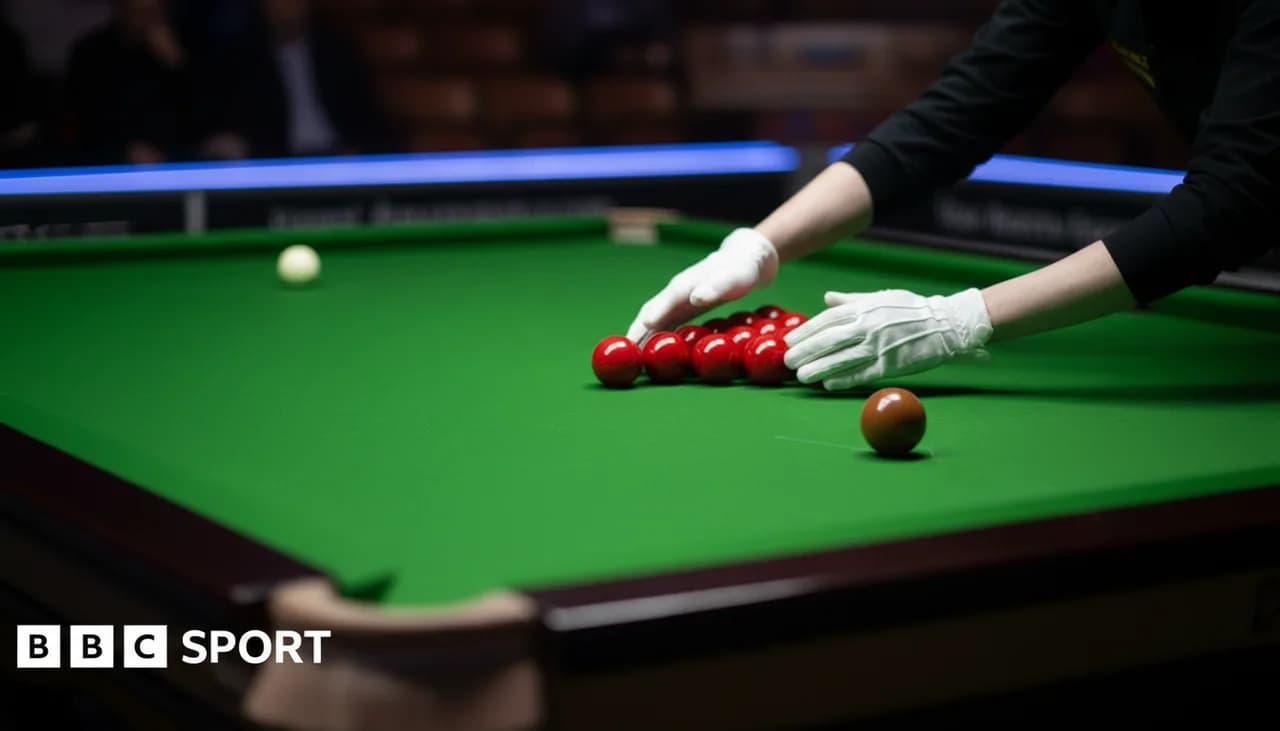
A free ball is one of snooker's more nuanced rulings, yet it carries significant tactical and scoring implications. It is awarded by the referee when a player is left snookered as a direct consequence of their opponent committing a foul — meaning the incoming player cannot strike the ball they are legally required to hit on both sides of its surface. In that situation, the referee may declare a free ball, permitting the player to nominate any other ball on the table as a substitute for the one they were originally due to play.
Three conditions must be satisfied before a free ball can be awarded. First, a foul must have been committed. Second, the incoming player must be unable to strike both sides of the colour of the ball they are required to hit. Third, the referee must determine that the resulting snooker is a direct consequence of that foul rather than incidental positioning. All three criteria are assessed independently by the referee on each occasion.
How the Scoring Works
The scoring mechanism for a free ball is straightforward but easy to misunderstand. If the nominated substitute ball is potted, the points awarded are equivalent to the value of the ball the player was originally required to hit — not the value of the ball that was actually potted. The most common scenario involves a player being snookered on a red. Should they nominate and pot, say, the black as their free ball, the shot is still credited as one point — the same value as a red — rather than the seven points ordinarily associated with potting the black.
Where the free ball rule produces its most striking arithmetic is in the sequence that follows. Because the nominated substitute ball is not removed from the table in the way a red would normally be, the total number of reds available for the remainder of the frame remains unchanged. The player therefore pots the free ball (one point), plays a colour in the normal fashion, and then resumes the standard red-colour sequence with the full complement of reds still available. That continuity of reds is precisely what creates the theoretical possibility of scoring beyond 147.
O'Sullivan's 153: The Rule in Its Most Dramatic Form
The practical consequence of that scoring structure was illustrated in remarkable fashion in March 2026, when Ronnie O'Sullivan compiled a break of 153 — a world record and, under ordinary circumstances, a total that should be mathematically impossible given that the maximum break in a conventional frame is 147.
O'Sullivan was awarded a free ball and chose to nominate the green. He potted it for one point, then followed with the black for seven — accumulating eight points before the break had even begun in earnest. Crucially, because a red had not been removed from the table during that sequence, O'Sullivan proceeded to pot 15 reds, accompanied by 13 blacks and two pinks, before clearing all six colours. That conventionally structured portion of the break was worth 145 points. Added to the eight points from the free ball sequence, the total reached 153.
It is worth noting that O'Sullivan's achievement, whilst extraordinary, does not alter the official status of 147 as the recognised maximum break. Under the sport's formal definitions, a maximum break refers specifically to a break comprising 15 reds, 15 blacks, and all six colours — a total of 147 points compiled without the assistance of a free ball. The 153 stands as a record for the highest break ever compiled in professional competition, but the two records are distinct in nature. O'Sullivan already holds more officially ratified 147 maximums than any other player in the sport's history, with 17 to his name according to data held on CueTracker.
Historical Context
The concept of a score exceeding 147 via the free ball mechanism has been understood within the game's rules for decades, though opportunities to achieve it in competitive play are inherently rare. A player must first be gifted a free ball with all 15 reds still on the table, then execute a flawless clearance — a combination of circumstances that, prior to O'Sullivan's effort, had not produced a 153 at the professional level. The theoretical maximum with a free ball is 155 (one point for the free ball nominated as a red substitute, seven for a black, then 15 reds with 15 blacks and all the colours), though achieving that precise sequence demands a level of fortune and precision that places it firmly in the realm of the extraordinary.
For viewers watching the free ball ruling in matches, the key point is this: it is a protective measure designed to prevent a player from being disadvantaged by their opponent's foul. The fact that it occasionally produces record-breaking arithmetic is, in the truest sense, a bonus.
