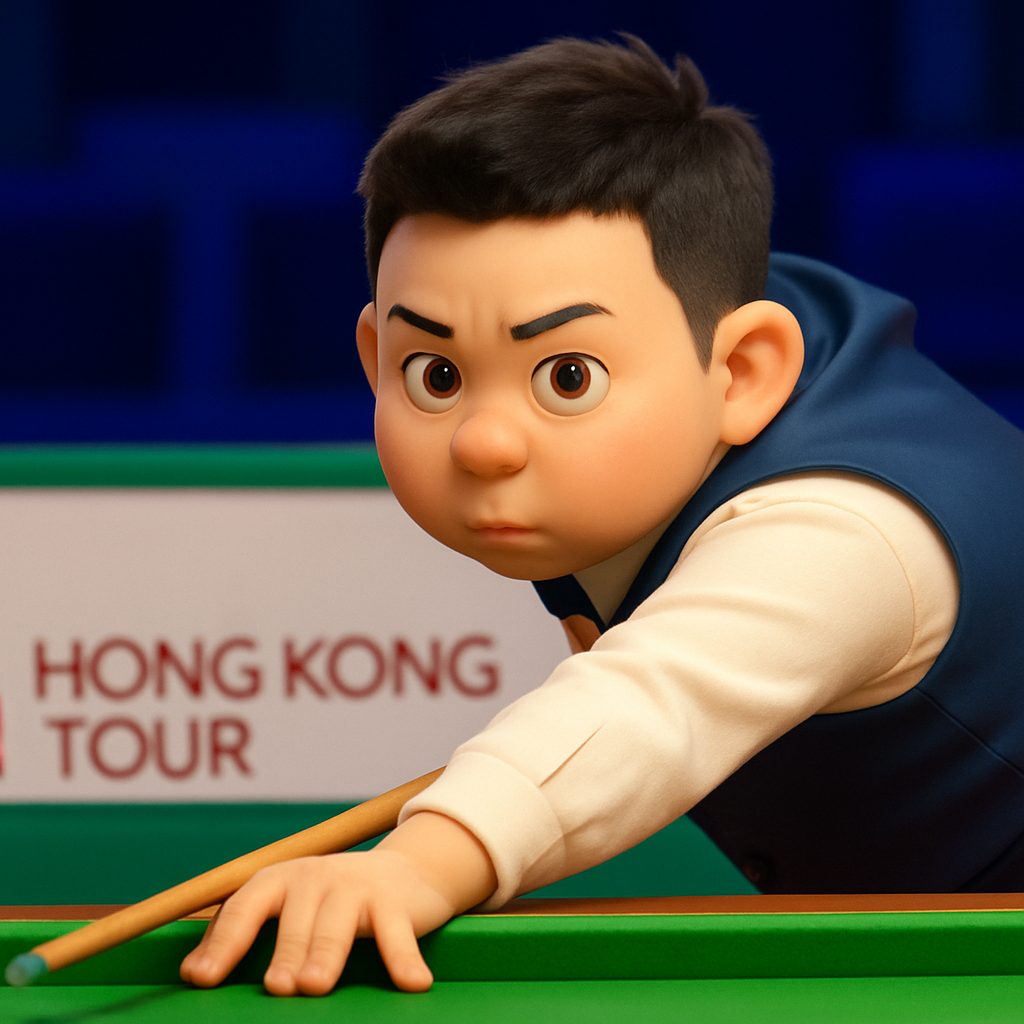
LEICESTER — Snooker history was made on a dramatic Friday night at the Morningside Arena, as the 2026 World Grand Prix quarter-finals concluded with a seismic shift in the sport's global order. For the first time in the 52-year history of ranking event snooker, all four semi-finalists will hail from China, marking a watershed moment that has been decades in the making.
The historic line-up was confirmed when Ding Junhui, the trailblazing veteran, defeated England's Judd Trump 5-3, joining his younger compatriots Zhang Anda, Si Jiahui, and He Guoqiang in the final four. This unprecedented clean sweep signifies the culmination of China's astronomical investment and passion for the green baize, a journey that began with a single television broadcast in the 1980s and has now produced a generation capable of dominating the sport at its highest level.
The Path to a Historic Semi-Final Line-Up
The quarter-finals unfolded like a script written to showcase Chinese snooker's depth and variety. In the afternoon session, Zhang Anda, the recent Champion of Champions winner, displayed steely resolve to overcome a resurgent Mark Williams 5-2. He was swiftly followed by Si Jiahui, the 2023 World Championship semi-finalist, who continued his blistering form with a 5-1 demolition of Iran's Hossein Vafaei, compiling breaks of 140 and 112.
The evening session saw the 20-year-old sensation He Guoqiang announce his arrival on the big stage, stunning world champion Luca Brecel 5-3 with a fearless, attacking performance. The stage was then set for Ding Junhui, the man who carried a nation's hopes alone for over a decade. In a high-quality clash against Trump, Ding held his nerve, sealing the historic moment with a sublime century break to win 5-3. As the final ball dropped, the significance was not lost on the commentary team or the rapt audience.
A Legacy Fifty-Two Years in the Making
To understand the magnitude of this achievement, one must look back. Since the first professional ranking tournament in 1974, the World Championship, the semi-final stages have been dominated by players from the British Isles, with occasional challenges from Canada, Australia, and Thailand. China's first major breakthrough came in 2005 when Ding won the China Open as an 18-year-old. His subsequent UK Championship victory later that year ignited the snooker boom back home. Yet, for years, Ding was a solitary figure at the business end of tournaments.
The change has been gradual but undeniable. The establishment of the World Snooker Tour's academy in Beijing, a packed calendar of events in China, and systemic youth coaching have created a conveyor belt of talent. Players like Liang Wenbo, Yan Bingtao (the 2021 Masters champion), and Zhao Xintong (the 2021 UK Champion) paved the way. Now, the generation behind them is arriving in force, equipped not just with skill, but with the belief that they belong. As snooker historian David Hendon noted, "This isn't a flash in the pan. This is the result of a structured, long-term project that has fundamentally altered snooker's ecosystem. The semi-finals in Leicester are the most visible fruit of that labour."
Reactions from the Snooker World
The reaction from within the sport has been one of awe and acceptance. World Snooker Tour chairman Steve Dawson stated, "While tonight is a historic moment for Chinese snooker, it is also a historic moment for our sport globally. It validates our international strategy and shows the incredible level the game has reached. The quality of play from all four Chinese players this week has been breathtaking."
Seven-time world champion Stephen Hendry, commentating for ITV, offered a poignant perspective: "I watched Ding carry the weight of a country for so long. To see him now, surrounded by this incredible wave of talent, and to be the one to officially secure this all-Chinese semi-final... it must be an incredibly emotional moment for him. He is no longer a pioneer; he is now the leader of a snooker superpower."
The players themselves were focused yet aware of the milestone. A humble Ding Junhui said in his post-match interview, "Of course, it is a special moment for China. But for us players, we are just trying to win every match. I am happy for the young players; they are very strong. Now we play each other, so someone from China will be in the final, which is good for our fans."
What This Means for the Future
The 2026 World Grand Prix semi-finals are more than a one-off event; they are a clear signal of snooker's new reality. The depth of the Chinese contingent means that multiple players are consistently reaching the latter stages of tournaments, creating a new dynamic on the tour. This shift presents both a challenge and an opportunity for the sport's traditional heartlands. The immediate implications are clear:
- Increased Global Interest: Broadcast and commercial interest in China, already massive, will reach new heights.
- Cultural Shift: The epicenter of snooker excellence is undeniably expanding eastwards, promising a more diverse and globally representative sport.
Barry Hearn, the former WST chairman who championed the sport's expansion into Asia, summed it up: "People asked me for years if we were creating a monster by developing snooker in China. I said we were creating a vibrant, sustainable future. This weekend, you're not seeing a monster; you're seeing a magnificent, talented dragon that has fully awakened. The game will never be the same, and frankly, that's brilliant for snooker."
Conclusion
As the Morningside Arena prepares for Saturday's semi-finals—Ding Junhui versus He Guoqiang, and Zhang Anda against Si Jiahui—the narrative has irrevocably changed. The question is no longer *if* a Chinese player will win, but *which* one. This historic all-Chinese semi-final is not an endpoint, but a definitive declaration of arrival. It confirms China's status as snooker's preeminent force, a nation that has moved from passionate consumer to prolific producer of world-class talent. The 52-year wait for such a moment is over, and the future of the sport now has a distinctly new, and global, face.